Overview
200/230 is the most widely used large core silica fiber spec: 200 µm core diameter, 230 µm cladding diameter. It is built as H-PCS — Hard-Polymer Clad Silica. The light-guiding core is high-purity quartz, wrapped in a hard polymer cladding, with a protective coating on the outside.
The point of this construction is the trade-off it makes. A quartz core keeps the wide spectral transmission and thermal headroom of silica. A polymer cladding delivers a numerical aperture far larger than all-silica fiber — light goes in easily, coupling tolerances are generous, and end-face preparation is less demanding. For applications that need stable power delivery and durability rather than ultra-low loss, this is the most cost-effective option.
FiberKinZ supplies 200/230 bare fiber on spools, finished patch cords, and matching SMA905 / ST connectors, with cut-to-length, termination, end-face treatment and armoring built to your project.
Fiber Structure
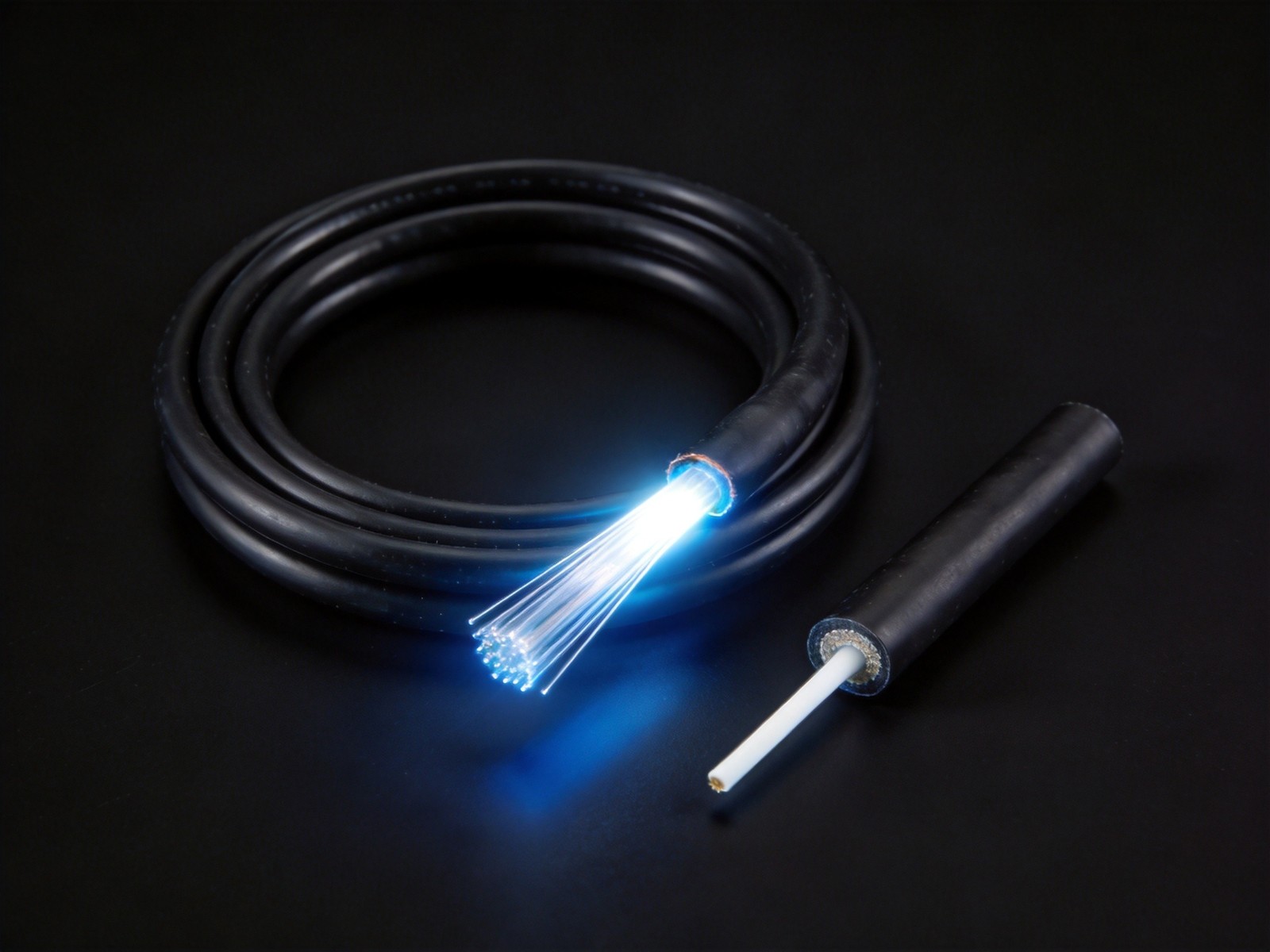
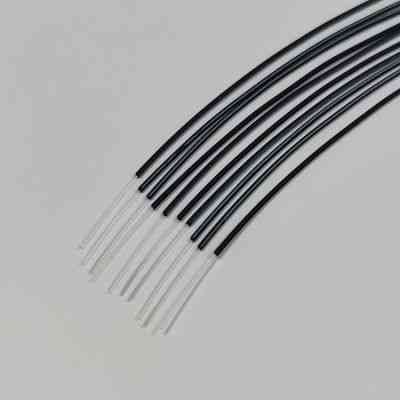
Specifications
| Item | 200/230 H-PCS |
|---|---|
| Core diameter | 200 µm |
| Cladding diameter | 230 µm |
| Core material | High-purity synthetic quartz |
| Cladding material | Hard polymer clad |
| Numerical aperture | Per supply datasheet |
| Operating wavelength | Visible to near-infrared, per datasheet |
| Service temperature | Limited by cladding and coating — per datasheet |
| Minimum bend radius | Per datasheet |
| Supply form | Bare fiber on spool / cut-to-length patch cord / terminated assembly |
Items marked "per datasheet" are batch-specific. Send us your wavelength, power and bend requirements and we will provide the full data for the matching batch.
Selection Guide
| Type | Core | Cladding | NA | Typical use |
|---|---|---|---|---|
| H-PCS 200/230 | Quartz | Hard polymer | High | Laser delivery, sensing, spectroscopy, illumination |
| All-silica fiber | Quartz | Quartz | Low | Long-haul telecom, ultra-low loss |
| POF | PMMA | Fluoropolymer | Very high | Short-range data, decorative lighting, side glow |
| HPCF | Quartz | Hard clad | High | Industrial data, sensing, short reach |
Rule of thumb: long distance and lowest loss points to all-silica; low cost and easy termination for decorative lighting points to POF; power delivery with temperature headroom, without all-silica coupling headaches, points to H-PCS 200/230.
Applications
Laser Delivery
Flexible delivery of low-to-medium power lasers, replacing part of a free-space path. Polished ends or a quartz end cap raise the power density ceiling; the exact limit is calculated from wavelength and CW/pulsed conditions.
Medical & Industrial Sensing
Spectroscopy, fluorescence excitation and collection, temperature and pressure probes. The large core raises light collection efficiency, and the probe tip can contact the medium directly.
Spectroscopy & Instrumentation
Optical path connections for spectrometers, colorimeters and inspection equipment. Broad transmission covers visible to near-infrared for multi-wavelength work.
Precision Illumination
Microscope illumination, machine vision light guides, endoscope illumination bundles. Multiple 200 µm fibers can be bundled into ring or spot output.
Matching Products
| Accessory | Details | Page |
|---|---|---|
| SMA905 connector | 230 µm bore ferrule, stainless steel or ceramic, threaded lock | View |
| ST connector | Bayonet lock, common in industrial and telecom interfaces | View |
| Finished patch cords | Cut to length, single or double ended, polished, armored | View |
| Fiber bundles | Multiple 200/230 fibers bundled for ring, spot or line output | View |
Frequently Asked Questions
What does 200/230 mean?
200/230 refers to two diameters: 200 µm core and 230 µm cladding. The first number is the light-guiding core, the second is the outer diameter including cladding. H-PCS fiber usually carries an additional protective coating, so the finished cable OD is larger than 230 µm.
How is H-PCS different from all-silica fiber?
All-silica fiber uses quartz for both core and cladding — low numerical aperture and sensitive to bend loss. H-PCS uses a quartz core with a hard polymer cladding, giving a much larger numerical aperture, easier coupling and better bend tolerance. The trade-off is a lower temperature ceiling, since long-term service temperature is limited by the polymer cladding.
Which connectors fit 200/230 fiber?
SMA905 is the most common choice, using a 230 µm or 231 µm bore ferrule. ST and certain industrial interfaces also work. Always match the ferrule bore to the cladding diameter — an oversized bore causes eccentricity and reduces coupling efficiency.
How much laser power can it handle?
The limit depends on core material, end-face preparation, wavelength and heat dissipation. A 200 µm core suits low-to-medium power delivery; polished end faces or a quartz end cap raise the damage threshold. Please share your wavelength and CW/pulsed conditions and we will specify accordingly.
Can you customize length and end-face treatment?
Yes. We cut to length, terminate one or both ends, polish or cleave the end face, add armor protection and mark serial numbers. Volume orders are built to your length, end-face and connector combination.
What other core sizes are available?
Large core silica fiber comes in core/cladding pairs — 400/440 and 600/660 alongside 200/230. Larger cores carry more light but require a larger bend radius and more demanding end-face work. Choose by actual spot size and coupling method, not simply the largest number.
Need a 200/230 sample or quotation?
Tell us your wavelength, power, length, end-face form and connector — we will propose a solution and quote against the actual conditions.
Request a Quote