Overview
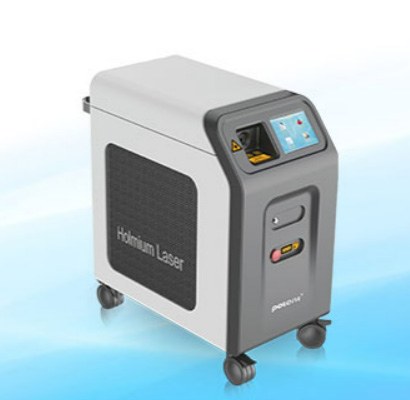
Holmium (Ho:YAG) lasers emit at 2100 nm in the mid-infrared. That wavelength is what makes holmium dominant in urology — water absorbs it extremely strongly, with penetration depth of only a fraction of a millimeter. Energy concentrates right at the stone or tissue surface, thermal damage to surrounding tissue stays small, and fragmentation, cutting and vaporization all follow from that.
The same property is what makes fiber selection hard. 2100 nm falls on a strong hydroxyl (OH⁻) absorption band. Hydroxyl impurities in standard silica fiber produce enormous absorption at this wavelength, so laser energy converts to heat in transit and the end face is destroyed quickly. Holmium fiber must therefore use low-OH silica, with hydroxyl content pushed below the ppm level, to bring 2100 nm loss down far enough to carry lithotripsy peak power.
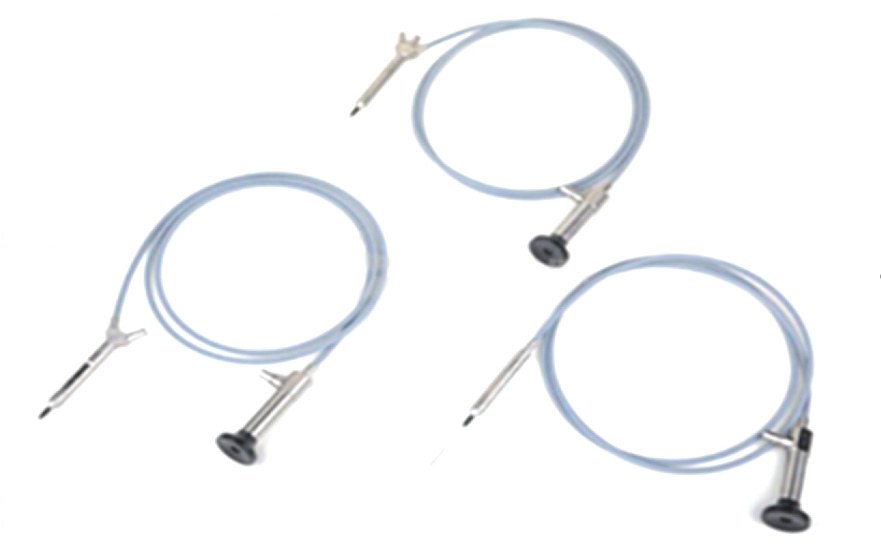
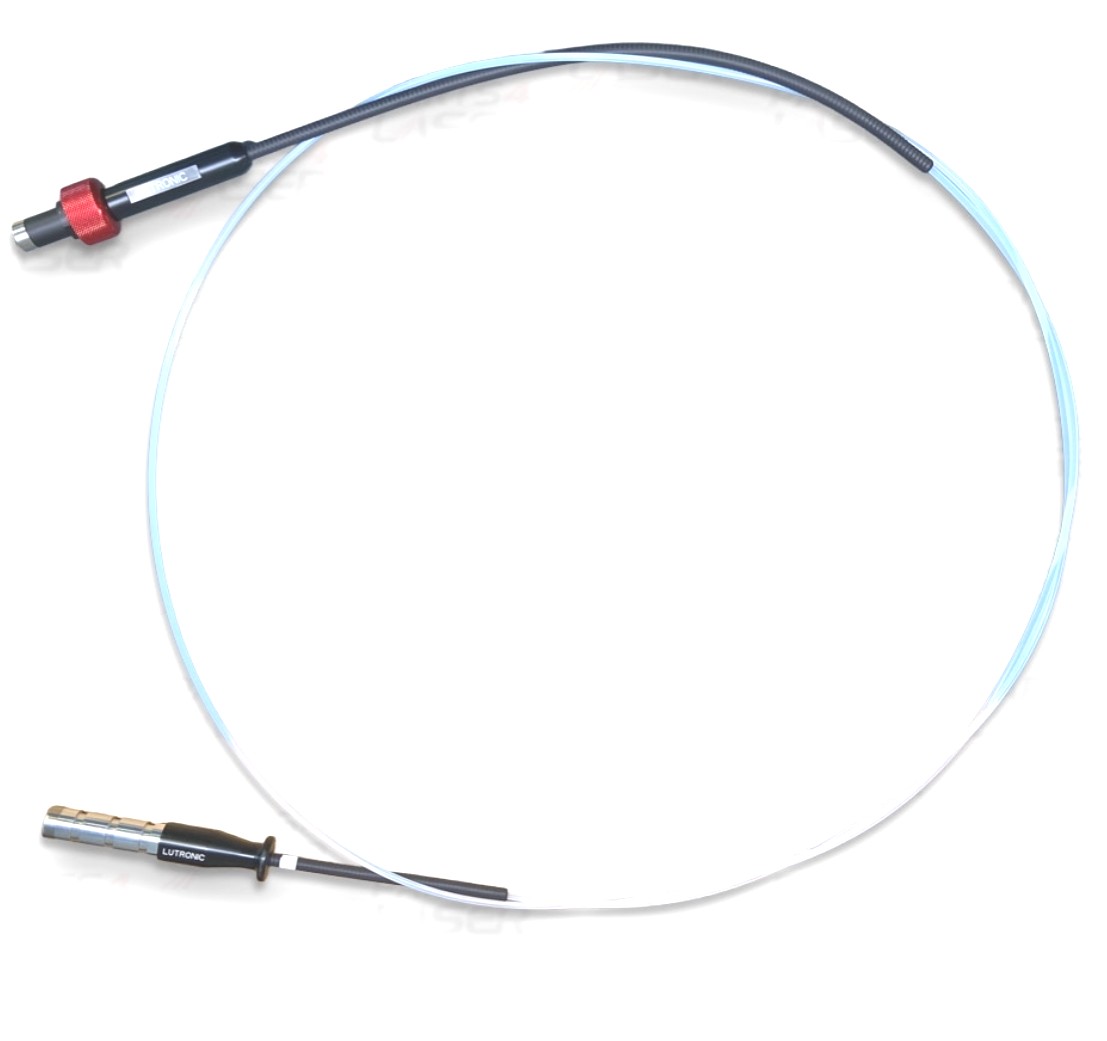
FiberKinZ supplies delivery fiber and finished fiber assemblies for holmium consoles: bare fiber, SMA905-terminated assemblies, and custom forms built to OEM interfaces. Core sizes cover the standard lithotripsy range, with medical-grade stripped and polished end faces.
Fiber Structure
Specifications
| Item | Holmium laser fiber (Ho:YAG 2100 nm) |
|---|---|
| Operating wavelength | 2100 nm (2.1 µm) |
| Core material | Low-OH synthetic silica |
| Cladding | Doped silica (all-silica construction) |
| Core / cladding ratio | Matched to core size |
| Standard core sizes | 200 / 272 / 365 / 550 / 1000 µm (selected by console and scope channel) |
| Numerical aperture | Per supply datasheet |
| Transmission loss | Per supply datasheet, at 2100 nm |
| Length | 3 m / 4 m and custom to console |
| Connector | SMA905 standard, custom to OEM interface |
| End face | Coating stripped, silica cladding exposed, polished |
| Supply form | Bare fiber / terminated fiber assembly |
Items marked "per supply datasheet" are batch-specific. Send us console model, output power, pulse width and repetition rate and we will specify the matching core size with full data.
Applications
Urology Lithotripsy
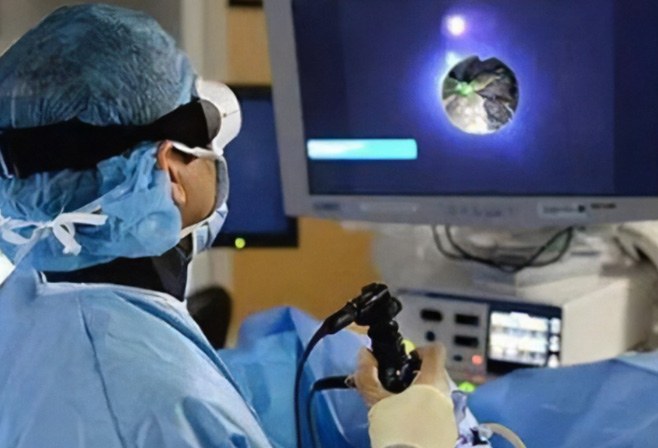
Intracorporeal fragmentation of renal, ureteral and bladder stones. 200–365 µm cores with flexible ureteroscopes reach difficult lower-pole locations; 550–1000 µm suits rigid scopes and large stone burdens with higher fragmentation efficiency.
HoLEP Prostate Enucleation
Holmium enucleation requires tissue cutting plus hemostasis. Larger cores are typical here, for power headroom and stable end-face condition over longer procedures.
Orthopedics & Spine
Disc decompression and joint debridement. The fiber must pass a long, narrow working channel, so flexibility and bend tolerance are the deciding factors.
ENT & Gynecology
Precise cutting and vaporization inside narrow cavities. Small cores pair with slim endoscopes.
Handling Notes
1. Strip the coating at the output end. The coating is an organic polymer with very strong 2100 nm absorption. Laser light reaching it carbonizes and burns it, then destroys the silica cladding. Confirm the output end has a stripped section exposing bare silica cladding, polished before use.
2. Contamination shortens fiber life. Firing with blood, tissue or fluid on the end face causes localized absorption, a temperature spike and end-face erosion. Keep the end face clean and inspect it before each firing.
3. Avoid prolonged dry firing in air. End-face temperature rise in air is far higher than in fluid. Lithotripsy should be performed in the irrigation medium.
4. Respect the bend radius. Over-bending leaks light through the cladding, causing local overheating and possibly breakage. Watch scope deflection and leave adequate fiber slack during flexible-scope work.
5. Replace when the end face whitens, roughens or shows burn marks. Holmium fiber is a consumable — falling transmission shows up as slower fragmentation and rising power demand.
Matching Products
| Accessory | Details | Page |
|---|---|---|
| SMA905 medical connector | Stainless steel or ceramic ferrule, 3/8-24 UNF thread, matched to console interface | View |
| Medical light-guide fiber | Endoscope cold-light transmission with SMA905 terminations | View |
| Large core silica fiber | 200/230 H-PCS and other general large-core specs | View |
| Medical solutions | Lithotripsy, aesthetic and endoscopy optical path solutions | View |
Frequently Asked Questions
Why must holmium laser fiber use low-OH silica?
The holmium wavelength of 2100 nm sits squarely on a strong absorption band of water and hydroxyl (OH) groups. Standard silica fiber absorbs heavily at this wavelength, so laser energy turns into heat and destroys the fiber end face. Low-OH silica pushes hydroxyl content below the ppm level, cutting absorption at 2100 nm enough to carry the high peak power lithotripsy requires.
Which core size should I choose for lithotripsy?
Common options are 200, 272, 365, 550 and 1000 µm. A small core is more flexible and fits the working channel of fine semi-rigid and flexible ureteroscopes, but power density is higher and the end face degrades faster. A large core gives more power headroom and faster fragmentation but needs a larger bend radius. Flexible-scope work typically uses 200–365 µm; rigid scopes and large stone burdens use 550–1000 µm. The right choice depends on console power, scope channel and deflection requirements.
Why must the coating be stripped at the output end?
The coating is an organic polymer with extremely high absorption at 2100 nm. Once laser light reaches it, it carbonizes and burns, which then destroys the silica cladding and breaks the fiber. Holmium fibers must therefore have a section of coating stripped at the output end, exposing the silica cladding, with the end face polished before use.
How much power can the fiber handle?
Capacity depends on core size, polish quality, power density, pulse energy, bend radius and whether the fiber fires in air or in fluid. A contaminated, rough or dry-fired end face loses damage threshold quickly. Send us console power, pulse width and repetition rate and we will specify the matching core size and end-face treatment.
Can you match the original console interface?
Yes. We build SMA905 and other connector forms to the OEM interface, including thread specification, ferrule bore and strain-relief dimensions. A console model number or connector drawing is enough for us to match.
Can the fiber be reused or sterilized?
Holmium fibers are consumables. Repeated use wears and burns the end face, reducing transmission efficiency. Whether reuse is acceptable depends on end-face condition and hospital infection-control policy; inspect for whitening, roughness or burn marks before reuse. Sterilization must follow the OEM and hospital protocol.
Need a holmium fiber sample or matched assembly?
Share the console model, output power, pulse parameters and scope channel size — we will specify core size, length and connector and quote accordingly.
Request a Quote