Home / Products / Patch Cords / Aesthetic Laser Fiber Patch Cords
Aesthetic Laser Fiber Patch Cords
Finished patch cords for hair removal, pigmentation, skin rejuvenation and vascular treatment platforms. This page skips generic claims about transmission and loss, and covers the three things that actually decide whether a cord fits and how long it lasts: end-face power density, wavelength versus material, and the device interface.
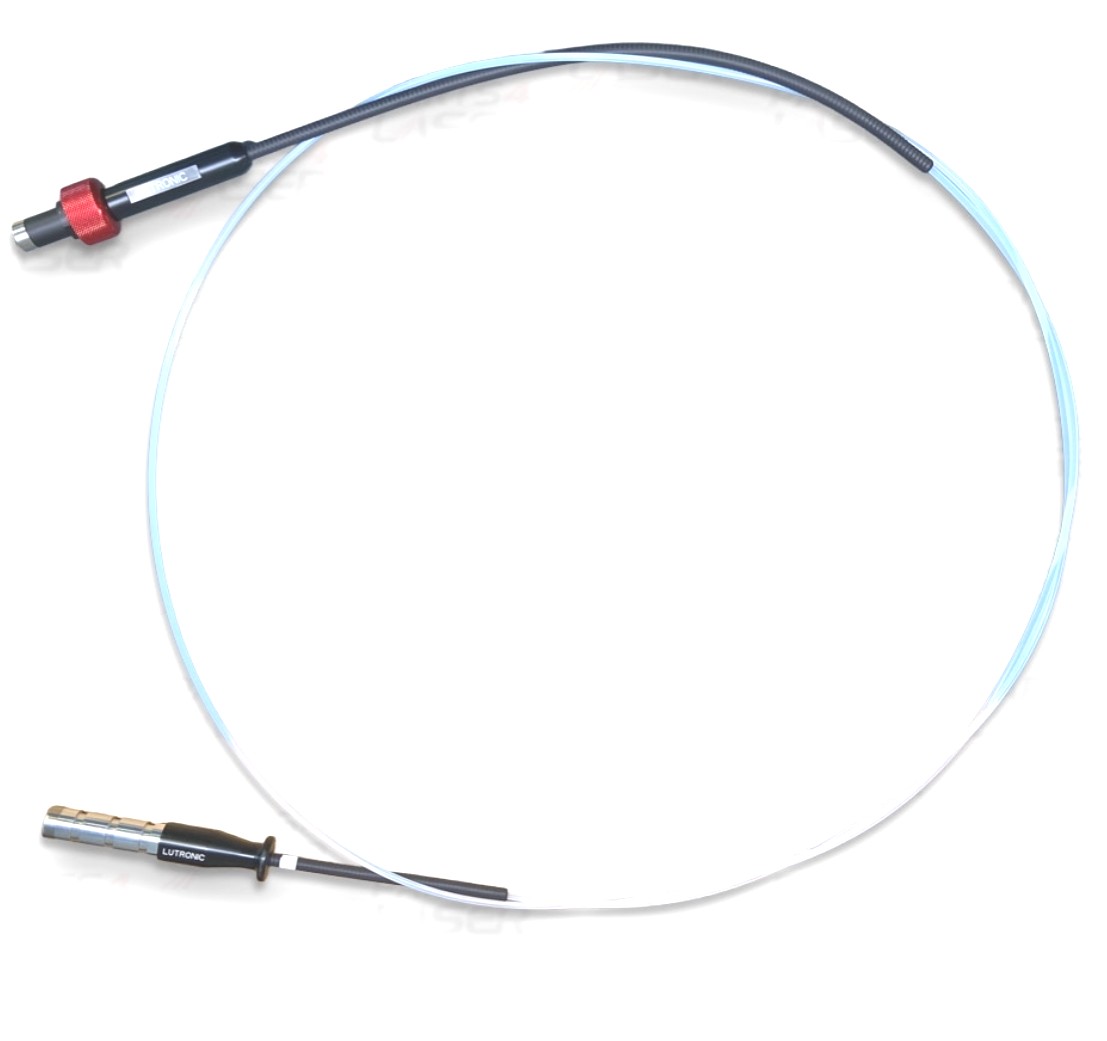
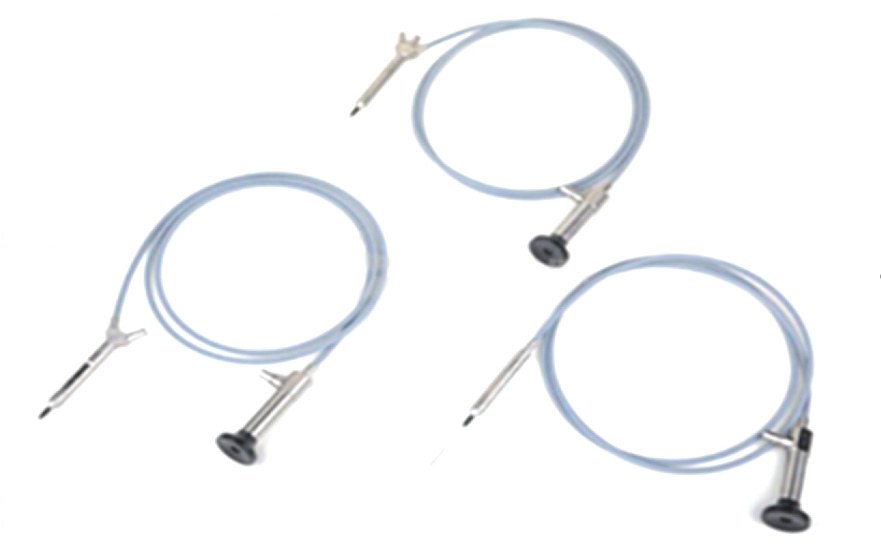
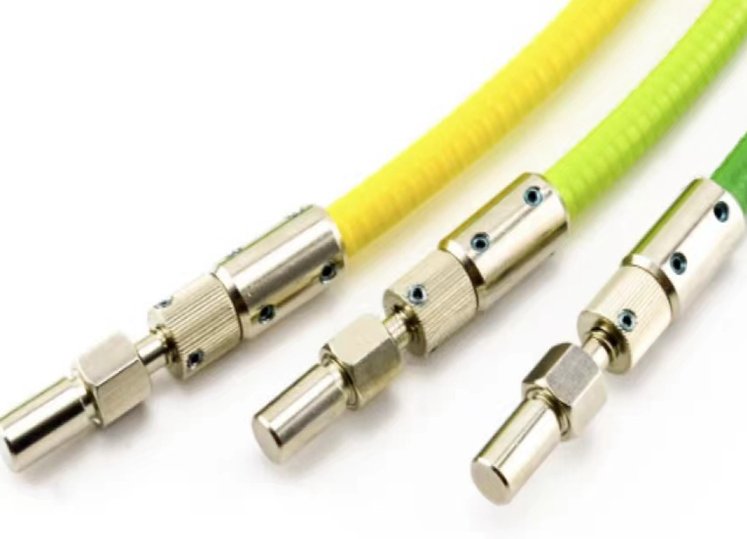
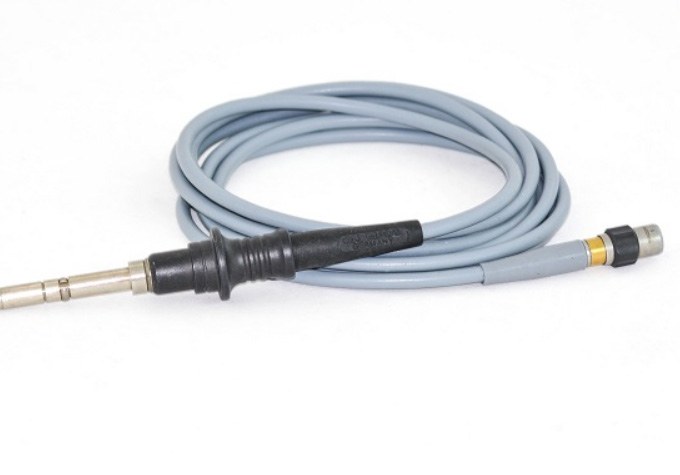
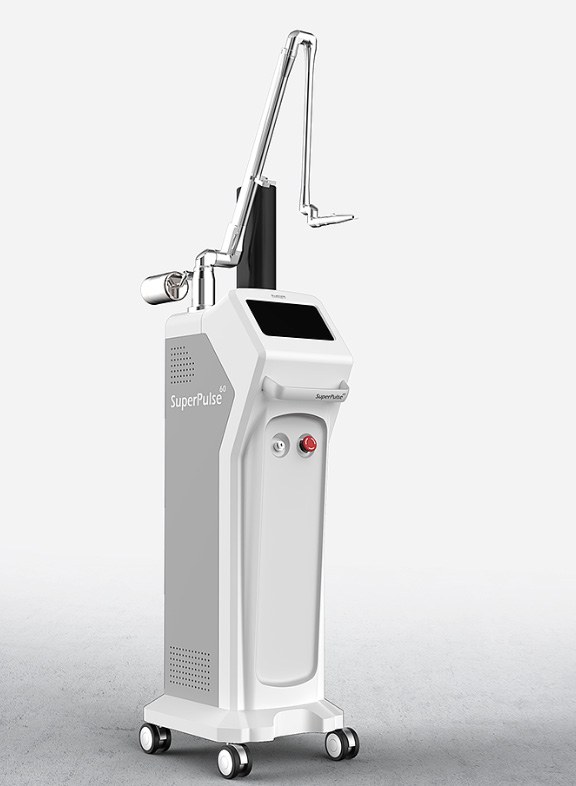
Photos on this page show cable assemblies from cooperating aesthetic device supply chains and armored laser fibers. They are not original parts of any specific brand. Interface fit must be confirmed against the actual receptacle on your device.
1. A cord is not one fiber — it is three stages
Customers often think of an aesthetic patch cord as a single cable. It is actually three stages, and each fails for a different reason:
| Stage | Function | Typical failure | How to diagnose |
|---|---|---|---|
| Device interface | Mates with the laser console, ensures alignment and locking | Worn interface, incomplete locking, contaminated ferrule | Check for play after insertion; look for indentation on the face |
| Transmission fiber | Delivers laser energy to the treatment end | Bend loss, armor rupture, core darkening | Measure loss straight, then at minimum bend radius, compare the delta |
| Treatment tip | Emits light, shapes the spot, contacts tissue | End-face burn, chipping, coating failure | Inspect under magnification; this is the stage that fails most |
More than 80% of returns fail at the third stage. And whether the third stage survives depends on the next section.
2. End-face power density: why small cores burn faster
This is the single most important point on the page. What burns an end face is power density — watts per unit area — not total laser power.
At the same 30 W output, core diameter changes the face loading by an order of magnitude:
| Core diameter | Face area | Power density at 30 W | Relative | Practical behaviour |
|---|---|---|---|---|
| 1000 um | ≈ 0.785 mm² | ≈ 38 W/mm² | 1x | Forgiving; tolerates light contamination |
| 600 um | ≈ 0.283 mm² | ≈ 106 W/mm² | 2.8x | Needs routine face inspection |
| 400 um | ≈ 0.126 mm² | ≈ 239 W/mm² | 6.3x | Burns readily once contaminated |
| 200 um | ≈ 0.031 mm² | ≈ 955 W/mm² | 25x | A speck of dust is enough to burn through; requires high-purity silica and premium face finish |
This table explains two common confusions:
- Why cord life collapses after switching to a smaller core on the same machine — it is physics, not a bad batch
- Why high-power systems use end caps — a cap expands the beam before it enters the core, lowering power density at the entrance face. It trades area for lifetime
A practical corollary: if your cords keep burning, calculate the power density first. Above roughly 200 W/mm², cleaning frequency and inspection criteria must step up a level. Buying a more expensive cord does not fix the underlying cause.
3. Wavelength decides the fiber material
This is the step most often skipped. Aesthetic lasers span 532 nm to 10600 nm, while silica has a limited transmission window:
| Laser type | Typical wavelength | Usable fiber | Notes |
|---|---|---|---|
| Frequency-doubled Nd:YAG | 532 nm | Silica | Usable; watch for photodarkening under sustained high power |
| Alexandrite | 755 nm | Silica | Workhorse hair-removal wavelength; transmits well |
| Diode | 808 nm | Silica | Most common hair removal; low-OH silica is sufficient |
| Nd:YAG | 1064 nm | Silica | Mature solution for vascular and pigmented lesions |
| Er:YAG | 2940 nm | Fluoride / hollow-core / articulated arm | Silica will not work — 2940 nm sits near the water OH absorption peak and dies within millimeters |
| CO₂ | 10600 nm | Articulated arm | Silica is essentially opaque; flexible fiber solutions are rare, mirror arms dominate |
So when a customer says "I need an aesthetic laser fiber", the first question is wavelength, not core diameter. Get the wavelength wrong and everything downstream is wrong.
4. Device interface: four checks, no guessing
Aesthetic device brands are numerous, interfaces are not standardized, and most carry keying features. We do not infer dimensions from a brand name — even models within one brand can differ. Check four things:
| Item | What to look at | Why it matters |
|---|---|---|
| Ferrule diameter | Receptacle bore diameter; 2.5 mm systems are common, custom sizes exist | Too large will not seat; too small wobbles and misaligns |
| Locking method | Threaded / bayonet / push-pull latch / screw clamp | Defines plug geometry; mismatched types simply will not mount |
| Insertion depth | Distance from flange face to emission point | Wrong depth shifts the emission point inside the handpiece and distorts the spot |
| Keying features | Keys, notches, asymmetric bosses | Forcing a keyed interface damages the device receptacle — far costlier than the cord |
The most reliable input is the old part or clear photos: connector body, thread, ferrule face, overall length. That beats any written model description.
5. Sterilization: half of reusability is decided here
| Method | Temperature | Effect on the cord | Suitability |
|---|---|---|---|
| Autoclave (steam) | 134 °C | Silica core survives, but connector adhesive ages and the jacket may deform; insertion loss creeps up over cycles | Must be confirmed per material — do not assume |
| ETO (ethylene oxide) | ~37–55 °C | Low temperature, gentle on fiber and adhesive; standard for medical fiber | Requires adequate aeration for residue |
| Chemical soak / wipe | Ambient | Depends on jacket and adhesive chemical resistance; alcohols are generally safe, strong oxidizers may attack | Confirm material compatibility |
| Single use | — | No sterilization, no cross-contamination risk | Higher cost; suited to high-risk settings |
One frequently missed point: the sterilization method must be decided at design stage, not retrofitted. Choose an adhesive that cannot take heat, and you cannot later switch to autoclave.
6. Reusable versus single-use: the real arithmetic
| Dimension | Reusable | Single-use |
|---|---|---|
| Cost per procedure | Low once amortized | High |
| Sterilization and inspection labour | Required every cycle — a hidden cost | None |
| Cross-contamination risk | Depends on process discipline | Low |
| Performance consistency | Drifts with cycle count | New part every time |
| Best fit | High power, low infection risk, established sterilization workflow | Lesion ablation, high infection risk, staff-constrained clinics |
Many clinics compare purchase price only and omit sterilization and inspection labour. Include the labour and the conclusion often reverses.
7. End-face inspection: four states and what to do
Inspect before each use under magnification or with a scope, and classify against this table:
| State | Cause | Consequence | Action |
|---|---|---|---|
| Clean and clear | — | Normal | Continue use |
| Dust / fingerprints | Storage or handling contamination | Localized absorption heats the spot — the starting point of burn-out | Clean with lint-free wipe and alcohol, then re-inspect |
| Brown burn mark | Contaminant carbonized by the beam | Transmission drops and keeps degrading | Re-polish if the design allows; otherwise replace |
| Pit / chip | Excessive power density or mechanical impact | Scattering rises; may damage the handpiece | Replace — do not continue using |
8. Choosing core diameter: follow the treatment, not the power
| Treatment type | Typical core range | Priority |
|---|---|---|
| Large-area hair removal | Larger core | Big spot and fast coverage; energy uniformity matters most |
| Pigmented lesions | Medium core | Balances fluence against spot control |
| Vascular lesions | Small to medium core | Needs higher fluence; face management is demanding |
| Precision / spot treatment | Small core | Highest power density, most fragile face |
Note these are directions, not absolute values. The specific core is set by the device optics and handpiece. Changing core diameter changes spot size and fluence, so parameters must be recalibrated — it is not a drop-in swap.
9. Minimum information set for quoting
All six items are needed; missing any one risks a wrong build:
| # | Information | Why it is required |
|---|---|---|
| 1 | Device brand + exact model | Interface differences follow the model, not the brand |
| 2 | Laser wavelength | Determines fiber material; wrong wavelength scraps the whole cord |
| 3 | Output power + mode (CW / pulsed) | Used to compute face power density; peak power is calculated separately |
| 4 | Core diameter | Tied to the handpiece and calibration parameters |
| 5 | Length | Affects transmission loss and working radius |
| 6 | Sterilization method | Sets adhesive and jacket material — decided at design stage |
10. Key parameters
| Item | Range / notes |
|---|---|
| Supported wavelengths | 532 / 755 / 808 / 1064 nm and other wavelengths within the silica window |
| Not supported by silica | 2940 nm (Er:YAG), 10600 nm (CO₂) — require fluoride or hollow-core fiber, or an articulated arm |
| Fiber types | Low-OH silica, armored silica, energy-delivery fiber |
| Core diameter | Matched to device and handpiece; 200–1000 um is the common range |
| Jacket | PVC / silicone / stainless steel spiral armor (crush resistance, bend limit) |
| Connectors | Customized to the receptacle: threaded, bayonet or push-pull |
| End finish | Polished; end cap available for high-power use to lower entrance power density |
| Sterilization | Confirmed per material and process (autoclave / ETO / chemical) |
| Testing | Insertion loss and face appearance measured per cord, with inspection record |
11. Related products
| Product | Relation to this page |
|---|---|
| Aesthetic laser fiber (bare / energy fiber) | The transmission stage sold separately, for in-house assembly or replacement |
| SMA905 connectors | Some aesthetic devices and handpieces use the SMA905 interface system |
| Medical fiber | Illumination and energy delivery fiber for endoscopy, lithotripsy and similar |
| POF patch cord range | Plastic optical fiber cords for lighting and data — a different product category |
12. Frequently asked questions
How often should an aesthetic patch cord be replaced?
There is no fixed count. Judge by end-face condition and insertion loss drift. Inspect under magnification before each sterilization cycle; replace when you find a burn mark, pit or chip that cannot be cleaned off, or when insertion loss rises more than 1 dB above baseline. Real service life ranges from tens to hundreds of cycles depending on power density, sterilization method and handling.
Why does a smaller core burn its end face faster at the same power?
Because what burns the face is power density, not total power. At 30 W, a 1000 um core has roughly 0.785 mm² of face area, about 38 W/mm²; a 200 um core has roughly 0.031 mm², about 955 W/mm² — a 25x difference. That is why small-core fibers demand far higher face quality and material purity.
Why are Er:YAG 2940 nm and CO₂ 10600 nm rarely delivered through fiber?
Silica absorbs strongly at both wavelengths. 2940 nm sits near the OH absorption peak of water, so a silica fiber attenuates within a few millimeters; 10600 nm behaves similarly. These platforms normally use an articulated arm with mirror joints instead of a flexible fiber. The few fiber-based approaches require fluoride (ZBLAN) or hollow-core fiber, which costs more and restricts bend radius.
Can the patch cord be autoclaved?
The silica fiber itself withstands 134 °C, but the adhesive at the connector and the jacket material may not. Repeated autoclaving ages the adhesive and loosens the connector, gradually raising insertion loss. ETO or chemical disinfection is gentler, provided the jacket material is compatible. Autoclave suitability must be confirmed against the specific cord's materials and build — it cannot be assumed.
Are patch cords interchangeable between aesthetic device brands?
No. Interfaces differ in ferrule diameter, thread spec, locking method and insertion depth, and most carry keying features. Forcing a mismatched plug damages the receptacle on the device, which costs far more than the cord. Even models within one brand may differ. Always specify the brand and exact model, not just "aesthetic device".
How do I tell whether an end face is still usable?
Under magnification or with an inspection scope, check three things: burn marks or brown discoloration, chips at the edge, and pits that cannot be wiped away. The first two can sometimes be recovered by re-polishing if the cord design allows it; a pit means replacement. If the visual check passes, measure insertion loss — both must pass before reuse.
Does armoring improve laser damage threshold?
No. Armoring in aesthetic cords usually means a stainless steel spiral conduit that resists crushing and pulling and limits bend radius. It protects mechanical integrity only. It does not change optical performance or raise the damage threshold — if the failure mode is end-face burn-out, armoring does not help.
What information is needed to quote a custom cord?
Six items: device brand and exact model, laser wavelength, output power and operating mode (CW or pulsed), required core diameter, length, and sterilization method. A sample of the old cord, or clear photos of the connector body, thread, ferrule face and overall length, is the most reliable input. Missing any one item risks a wrong build.
Need a cord matched to your aesthetic device?
Send us the device brand and model, wavelength, power, core diameter, length and sterilization method. We will verify against the actual interface before quoting. A sample of the old cord is the most accurate reference.