Overview
HPCF solves a very specific conflict: silica fiber performs well but is awkward to use, while plastic fiber is easy to use but does not perform well enough.
All-silica fiber (GOF) uses silica for both core and cladding. Loss is low and temperature tolerance is high, but the numerical aperture is small — typically 0.22 — so the acceptance cone is narrow, alignment must be precise, bend radius is large and cost is high. Plastic optical fiber (POF) has a large core, terminates easily and bends freely, but attenuates heavily and cannot take much heat, limiting it to short-run lighting and signalling.
HPCF takes the middle path: a high-purity silica core with a hard polymer cladding. A polymer cladding can be formulated with a very low refractive index, so NA reaches roughly 0.37 — light collection close to POF — while the transmission medium remains silica, giving far better attenuation and temperature tolerance than POF. Because the cladding is not silica, drawing temperature is lower and the process simpler, so cost sits well below all-silica.
The trade-off is that the polymer cladding limits temperature and power. That gives HPCF a clear position: medium-power laser delivery, medical light guides, industrial sensing and short-run high-reliability links — wherever high NA and bend tolerance matter, but sustained 200 °C operation or very high power does not.
Construction
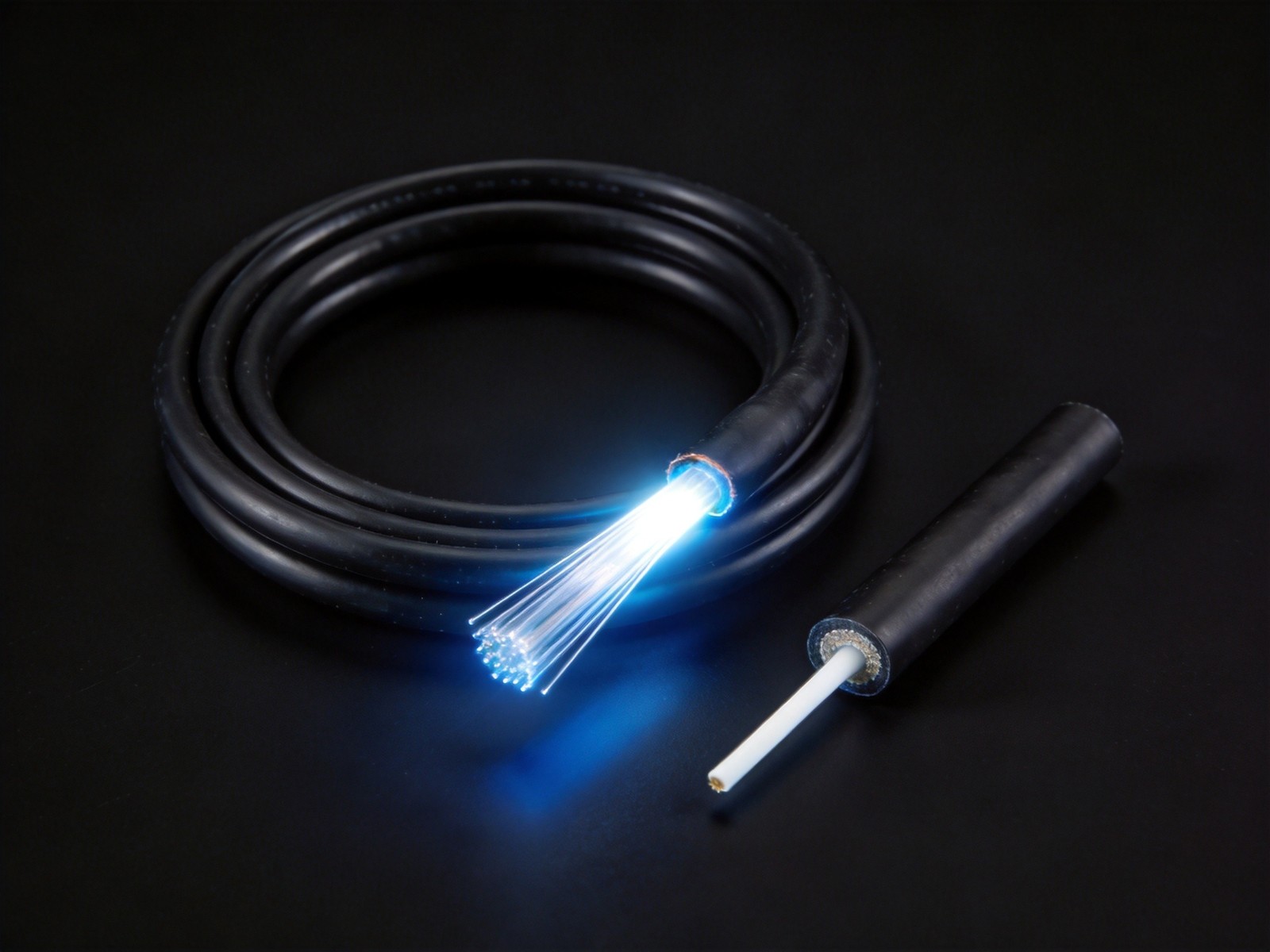
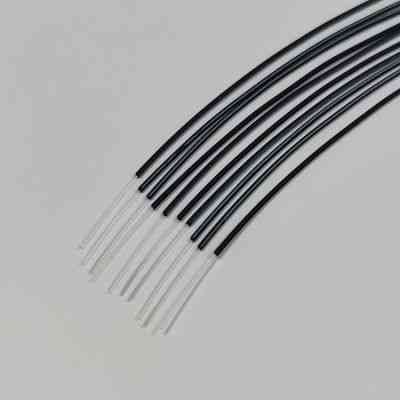
Three layers: silica core (transmission) → hard polymer cladding (index step, defines NA) → coating or jacket (mechanical and environmental protection). Cladding thickness is only around ten to twenty micrometres, so mechanical strength is limited and bare fiber is rarely installed directly — it normally carries a coating or becomes a finished cable.
Stock Core Sizes
| Core / cladding | Typical NA | Characteristics | Typical use |
|---|---|---|---|
| 100 / 110 µm | ≈ 0.37 | Finest, most flexible | Precision sensing, spectroscopy, slim medical devices |
| 200 / 230 µm | ≈ 0.37 | General workhorse, balanced performance and flexibility | Laser delivery, sensing, medical light guides |
| 400 / 440 µm | ≈ 0.37 | High throughput, medium power | Laser delivery, industrial lighting, spectral collection |
| 600 / 660 µm | ≈ 0.37 | High throughput, improved power handling | Laser processing, medical, high-power lighting |
| 800 / 880 µm | ≈ 0.37 | Large core, needs a larger bend radius | High-power laser delivery, industrial light guides |
| 1000 / 1100 µm | ≈ 0.37 | Largest core, output approaching POF | High-power laser, short-run high-brightness lighting |
Stock sizes shown; non-standard cores, custom NA and alternate cladding materials are built to project. Exact values per datasheet.
HPCF vs. GOF vs. POF
The question we are asked most often — answered in one table:
| Item | POF plastic fiber | HPCF hard-polymer clad | GOF all-silica |
|---|---|---|---|
| Core / cladding | PMMA / fluoropolymer | Silica / hard polymer | Silica / silica |
| Numerical aperture | ≈ 0.5 | ≈ 0.37 | ≈ 0.22 |
| Attenuation | High (≈ 0.15–0.25 dB/m) | Low | Lowest |
| Continuous temperature | ≤ 70 °C | Below ≈ 150 °C | Above 300 °C possible |
| Power handling | Low | Medium | High |
| Bend tolerance | Best | Good | Moderate |
| Alignment tolerance | Forgiving | Moderate | Demanding |
| Cost | Lowest | Medium | Highest |
| Typical application | Decorative lighting, short-run signals | Laser delivery, medical, sensing | High power, high temperature, long distance |
Decision order: temperature first — above 85 °C rules out POF; then power — high power favours GOF; for everything remaining that needs high NA, good bending and controlled cost, HPCF is the answer.
Applications
Laser Delivery
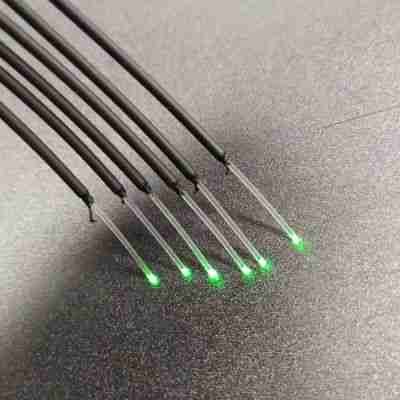
Flexible delivery for medical and industrial lasers. The end face needs cladding stripping or an end cap so the polymer does not absorb and overheat. Core size and end-face geometry follow power and wavelength.
Medical Light Guides
Endoscope cold-light sources, dental and dermatological treatment, spectral diagnostics. Supplied as finished bundles with metal SMA905 connectors and sterilizable constructions.
Industrial Sensing
Temperature, pressure, displacement and spectral collection. High NA makes coupling easier, and the fiber is immune to EMI — suited to power-heavy and harsh environments.
Industrial Illumination
In-machine lighting, machine vision sources, light routing into confined spaces. Better temperature tolerance than POF means it can sit closer to heat sources.
Matching Products
| Accessory | Details | Page |
|---|---|---|
| SMA905 connector | Stainless steel or ceramic ferrule, 3/8-24 UNF thread — the common medical and laser interface | View |
| ST / FC connectors | Metal housings for industrial field use | View |
| HPCF patch cords | Finished cables, custom lengths and connector combinations, armour optional | View |
| Large-core GOF | The upgrade path when higher temperature or power is required | View |
Frequently Asked Questions
What is the difference between HPCF and all-silica fiber (GOF)?
The cladding material is the core difference. HPCF pairs a silica core with a hard polymer cladding; GOF uses a silica cladding. Because a polymer cladding can be formulated with a very low refractive index, HPCF reaches a much higher numerical aperture, typically around 0.37, giving strong light collection, better bend tolerance and lower cost. The trade-off is that a polymer cladding handles less temperature and less power than a silica cladding. For sustained high temperature or high power choose GOF; for high NA, easy bending and controlled cost choose HPCF.
How much temperature can HPCF take?
It depends on the cladding and coating materials. Standard hard-polymer clad fiber typically operates continuously below about 150 °C, with higher short-term limits. For sustained operation above 200 °C, move to all-silica fiber or a metal-coated specialty type. Always state the actual working temperature during selection — core material alone does not answer the question.
What do the numbers 200/230 mean?
The figure before the slash is core diameter and after the slash is cladding diameter, both in micrometres. 200/230 means a 200 µm core with a 230 µm cladding — only 15 µm of cladding thickness. That thickness governs mechanical strength and bend tolerance, which is why HPCF is normally given an additional coating or jacket before field installation.
How much laser power can HPCF carry?
Polymer cladding temperature limits make HPCF's power handling lower than all-silica fiber. The actual threshold depends on wavelength, core size, continuous versus pulsed operation, and end-face treatment. High-power work requires end preparation — stripping the cladding to expose a pure silica end, or adding an end cap — plus power ageing validation. Send your laser parameters and we will specify the fiber construction and end-face solution.
How is the end face prepared?
Normally cleaved, ground and polished. For high power the polymer cladding is stripped back a defined length so light enters and exits through a pure silica face, preventing cladding absorption and burn-out; at higher power still, a silica end cap spreads the beam and lowers power density. Strip length and end-face geometry follow the laser parameters.
Which connectors fit?
SMA905, ST and FC standard interfaces are common, and custom interfaces can be built to the equipment. Medical and laser equipment usually uses a metal SMA905 connector with a precision ferrule. Connector-to-fiber fit directly affects coupling efficiency, so fiber and connector are best selected together.
When should I choose HPCF over POF?
Look at temperature and distance. POF is inexpensive, easy to terminate and very bendable, but continuous operation is generally limited to about 70 °C and attenuation is high. If ambient temperature exceeds 85 °C, lower attenuation is needed, or laser power must be carried, choose HPCF. Decorative lighting is more economical in POF; equipment and sensing applications are more reliable in HPCF.
Need an HPCF sample or selection support?
Tell us the laser wavelength and power, working temperature, transmission distance and connector type — we will specify core size, cladding material and end-face treatment as one package.
Request a Quote