First, Settle One Thing: Imaging or Illumination
These two products look almost identical, both are a bundle of fine fibers, but they serve completely different purposes. This is the single most common sourcing mistake.
| Item | Coherent bundle (imaging) | Incoherent bundle (light guide) |
|---|---|---|
| Fiber arrangement | Strict one-to-one position match between input and output | Random, no correspondence required |
| Transmits an image | Yes, intact | No, light only |
| Key metrics | Core count, fiber diameter, broken fiber rate, resolution | Total flux, output uniformity, branch count |
| Typical use | Endoscopes, borescopes, machine vision | Illumination, multi-point output, sensing excitation |
| Manufacturing difficulty | High, alignment accuracy drives image quality | Low, only flux matters |
| Price | High | Low |
The test is simple: if the customer wants to "see an image", it is a coherent bundle; if they want to "deliver light", it is an incoherent one. If someone just says "fiber bundle" without specifying, always ask what it is for.
Imaging Principle
The diagram marks why a broken fiber is fatal: each fiber maps to one fixed pixel in the output, so a break leaves a permanent hole at a fixed position. This is not random noise, it is a permanent defect. That is why broken fiber rate is the number one quality metric for an image bundle.
Hexagonal Packing
Hexagonal packing minimizes the voids inside a round bundle. There is an unavoidable trade-off here: finer fiber raises resolution, but cladding takes a larger share, fill factor drops, transmission efficiency falls, and manufacturing difficulty and cost rise. Do not chase core count alone. Work backwards from the smallest feature that must be resolved.
How to Specify
| Parameter | Common Range | How to Use It |
|---|---|---|
| Core count | 3k / 6k / 10k / 30k / 60k | Sets the resolution ceiling, not the only factor |
| Fiber diameter | 8-30 micron | Finer means higher resolution, lower throughput |
| Numerical aperture | approx. 0.35-0.6 | Sets acceptance angle, affects field of view and brightness |
| Broken fiber rate | typically below 1% | Stricter for medical; require an inspection report |
| Bundle diameter | Derived from core count and fiber diameter | Lock this first when channel size is constrained |
| Length | Commonly 0.5-3 m | Longer means more loss and higher breakage risk |
| End face shape | Round / square / rectangular / custom | Input and output can differ, for magnification or sensor matching |
| Operating temperature | Per material and package | High temperature or sterilization needs separate confirmation |
At minimum, specify four things: purpose (imaging or illumination), bundle diameter or channel constraint, smallest feature to resolve, and working distance. A core count alone cannot be quoted accurately.
Product Forms
Coherent Image Bundle
Position-matched at both ends, transmits a whole image. For endoscopes, borescopes and machine vision. Custom and dissimilar end shapes available.
Incoherent Light Guide
Random arrangement, light only. For illumination, sensing excitation and laser delivery. Accepted on total flux and output uniformity.
Branched Light Guide
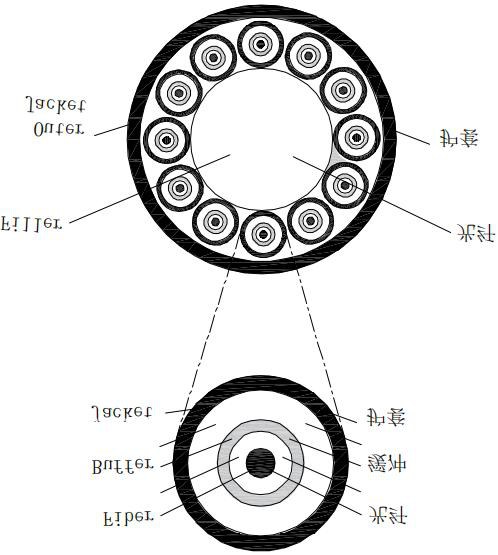
One input, multiple outputs, commonly 2 to a dozen branches. For multi-point illumination and excitation. Flux per branch splits by cross section.
Ring & Custom Shapes
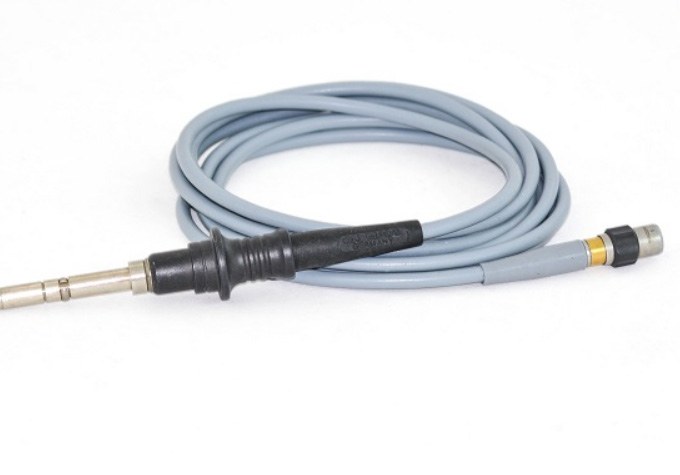
Ring output for coaxial illumination and endoscope ring lighting, plus rectangular, D-shaped and other custom end faces to drawing.
Applications
| Application | Type Used | Key Requirement |
|---|---|---|
| Medical endoscope | Coherent image bundle + ring light guide | Broken fiber rate, sterilizability, small diameter |
| Industrial borescope | Coherent image bundle | Abrasion-resistant jacket, length, flex life |
| Machine vision slit inspection | Coherent image bundle (linear array) | End face straightness, alignment accuracy |
| Imaging in EMI or high temperature | Coherent image bundle | Passive, non-conductive, temperature rating |
| Equipment illumination | Incoherent light guide | Total flux, output uniformity |
| Multi-point lighting or excitation | Branched light guide | Branch count, minimum illuminance per point |
Frequently Asked Questions
What is the difference between a coherent and an incoherent bundle?
In a coherent bundle every fiber keeps exactly the same relative position at the input and the output, so an image passes through intact. This is an image bundle. In an incoherent bundle the fiber positions are random, so light gets through but the image does not, which makes it a light guide used to move light from one point to another or to several points. The two look almost identical, so always confirm the intended use before quoting.
How do I choose the core count?
Core count sets the upper limit on resolution but it is not the only factor. Common values are 3k, 6k, 10k, 30k and 60k. For the same core count, a smaller bundle diameter means finer individual fibers and higher resolution, but lower fill factor, lower transmission efficiency and harder manufacturing. Specify core count, bundle diameter or fiber diameter, working distance and the smallest feature that must be resolved together.
Why does broken fiber rate matter?
A broken fiber produces a fixed black dot at a fixed position in the output image, permanently. Broken fiber rate is one of the most important quality metrics for an image bundle, typically required below 1 percent, with medical endoscope bundles held to tighter limits. Ask for a broken fiber inspection report and agree the acceptance method and criteria in advance rather than judging by eye on a sample.
Can bundles be made longer?
Yes, but imaging use has practical limits. Longer image bundles accumulate more loss, carry higher breakage risk and cost rises sharply; 0.5 to 3 m is the common range. Pure light guide bundles can be longer because position correspondence is not required and a few broken fibers barely affect total throughput. Lengths beyond the normal range are evaluated per project.
What end face shapes are possible?
Round is most common, but square, rectangular and custom shapes to drawing are available. The input and output can have different shapes, for example a round input expanded to a rectangular output to magnify the image or match a sensor format. Custom shapes demand tighter alignment accuracy, so drawings and tolerances are required.
How does this compare with a lens and CMOS camera?
Where there is room for a lens and a sensor, CMOS is simpler and cheaper. The value of an image bundle lies in extremely constrained situations: curved channels only a few millimeters across, strong electromagnetic fields, high temperature, radiation, or locations where powered electronics cannot enter. In those cases an electrical imaging solution will not fit or is not safe, and a bundle is one of the few viable answers.
How many branches can a light guide be split into?
Typically 2 up to a dozen or more, depending on the number of output points and the flux needed at each. After splitting, flux per branch falls in proportion to cross section, so calculate the minimum required illuminance at each point first and then set the branch count. Branch junctions are potted and cured for protection, and the split angle and jacket construction affect flex life, so confirm them on the drawing.
Related Products
| Item | Notes | Page |
|---|---|---|
| SMA905 connectors | Endoscope cold light source and bundle interface | View |
| Medical light cables | Assemblies with armor options | View |
| Silica fiber | UV to NIR transmission | View HPCF |
| LED light source | Cold light source unit for light guides | View |
Need an image bundle or light guide?
Tell us the purpose (imaging or illumination), channel diameter constraint, smallest feature to resolve, working distance and length. We will propose core count, fiber diameter and end face configuration.
Get Quote