First, a clarification: F07 and DL-72 are the same product
This is where purchasing gets confused. One duplex industrial optical connector is referenced under two naming systems running in parallel:
| Designation | Origin | Common forms |
|---|---|---|
| F07 | Japanese JIS system | F07, JIS F07 |
| DL-72 | Mitsubishi Electric naming | DL-72, DL-72ME |
| Other vendor equivalents | Sumitomo and others | CF-2071, CA7003, CA7103 |
They refer to the same interface family, not two products. A customer asking for F07 and one asking for DL-72 almost certainly want the same thing. Equally, do not assume you need to source two separate items when you hear both names.
F05 versus F07: channel count
| Item | F05 | F07 (DL-72) |
|---|---|---|
| Channels | Simplex | Duplex |
| Fiber | 1000 μm (POF class) | H-PCF 200/250 μm or HCS |
| Clamp range | About 2.2 mm | By cable OD, commonly 2.8-6.0 mm |
| Typical use | Digital audio, factory automation, office automation | Servo communication, PLC optical networks, elevators, placement machines |
| Locking | Push-in latch | Push-in latch |
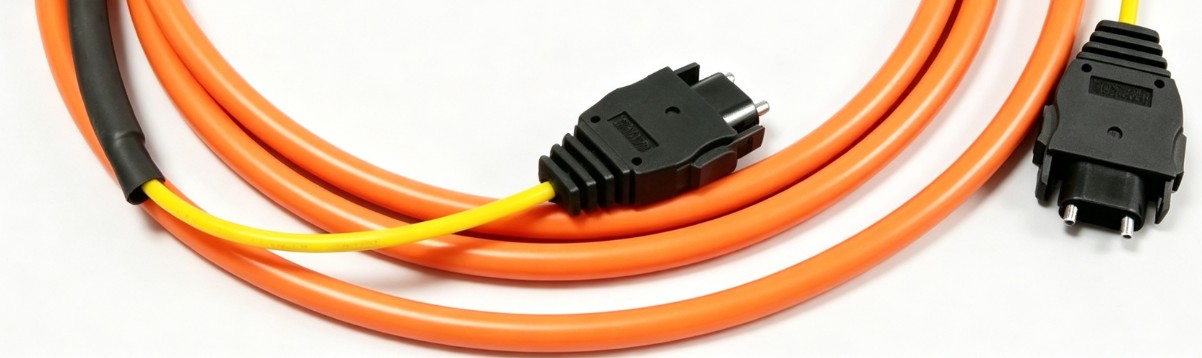
The identification is simple: count the holes on the equipment receptacle. One hole is F05, two holes is F07. Do not guess from the model number, because F05 has the smaller number but the thicker fiber at 1000 μm, while F07 has the larger number and the thinner 200/250 μm fiber.
It uses H-PCF, not ordinary silica and not POF
This is the highest error rate item in selection. The F07 family uses H-PCF (hard polymer clad fiber), commonly 200/250 μm, or HCS.
| Fiber type | Usable | Reason |
|---|---|---|
| H-PCF 200/250 μm | Standard | NA about 0.37, matched to these industrial transceivers |
| HCS | Usable | Same hard clad construction, verify transceiver compatibility |
| Ordinary multimode 50/125, 62.5/125 | Not recommended | NA about 0.20, mismatched to the module, poor coupling |
| Ordinary singlemode 9/125 | Not usable | NA and core size both far off, link will not work |
| POF plastic optical fiber | Not usable | 1000 μm class core will not enter the F07 ferrule |
With the wrong fiber type the connector physically fits but the link fails or loss is abnormal, and troubleshooting takes time. Always provide both the equipment model and the cable model when requesting a quote, not simply "an F07 cable".
Where It Is Used
Servo communication
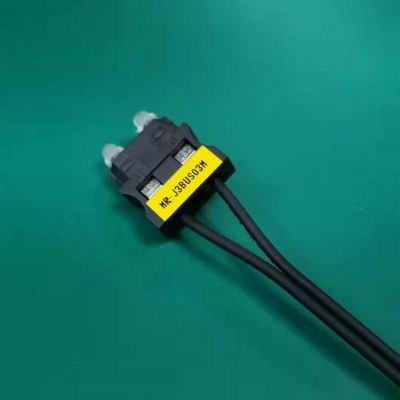
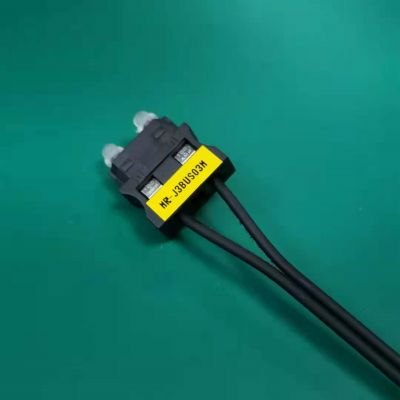
Mitsubishi MR-J3-B series SSCNET III optical communication, connecting servo amplifier to motor with duplex cable. This is the largest volume application and the main source of repair replacement demand.
PLC optical networks
Mitsubishi MELSECNET/H optical network, station to station up to 400 m at 25 Mbps. DL-72ME connectors on H-PCF cable give long distance with strong noise immunity.
CNC and special machines
Hitachi drilling machines, placement machines and various CNC axis links. The equipment tends to be older, and original spares are expensive with long lead times.
Elevators and automation
Elevator control systems, Omron SYSMAC systems, factory automation lines. The common factor is that the equipment is in service and cannot stop.
How It Differs from ST / SC / LC
| Item | F05 / F07 | ST | SC / LC |
|---|---|---|---|
| Positioning | Dedicated inside equipment | General industrial and sensing | Telecom and data centers |
| Fiber type | Mainly H-PCF / HCS | POF, multimode, singlemode | Singlemode, multimode |
| Channels | 1 (F05) / 2 (F07) | Single | Single / duplex |
| Interchangeability | Only within the same ecosystem | General | General |
| Selection logic | One to one replacement of the original interface | Choose by specification | Choose by standard |
| Typical buyer | Equipment repair, line maintenance, OEM | Equipment makers, projects | Telecom, machine rooms |
The essential difference is in the last row: ST, SC and LC are general interfaces chosen by specification, while F05 and F07 are equipment specific interfaces chosen by equipment. That is why an enquiry for this product usually opens with "I have a machine that..." rather than "I need these parameters".
Repair Replacement Is the Main Demand
Purchasing for this product is highly concentrated: more than eight in ten enquiries are equipment repair. Fiber harnesses fail in service for a few recurring reasons:
| Failure mode | Symptom | How to confirm |
|---|---|---|
| Drag chain fatigue | Intermittent alarms, changes when the cable is flexed | Flex test plus power meter section measurement |
| Connector pull out / debonding | Completely dead, or sudden loss increase | Inject light one end, check the other |
| End face contamination | Elevated loss but link works | Light present but power clearly below nominal |
| Excessive bending | Rising loss, core breaks over time | Check whether routing radius is under ten times cable OD |
The replacement approach: provide the original model, equipment model or a photo of the old part, and we build to the original interface and length. The interface and fiber type must match, while length and jacket construction can follow the installation. That flexibility matters in the field, because the original standard length rarely matches the actual routing.
What We Need to Specify
| Item | Why | Typical answer |
|---|---|---|
| Equipment model | Determines interface family and fiber type | e.g. Mitsubishi MR-J3-xx, MELSECNET/H module |
| Original connector model | Direct cross reference | F07, DL-72, DL-72ME, CF-2071 |
| Channel count | Distinguishes F05 from F07 | Simplex / duplex |
| Cable model | Determines fiber specification | H-PCF 200/250, HCS |
| Length | Follows the installation | Custom lengths available |
| Environment | Determines jacket construction | Drag chain, fixed, oil, outdoor |
A photo of the old part is the easiest route; we can compare the interface directly. Equipment model plus original connector model is also sufficient.
Key Parameters
| Item | Typical Value |
|---|---|
| Interface standard | Japanese JIS industrial optical |
| Channels | F05 simplex / F07 duplex |
| Fiber | H-PCF 200/250 μm, HCS; F05 uses 1000 μm |
| Locking | Push-in latch |
| Operating temperature | By jacket material, typically -20 to +70C |
| Insertion loss | By fiber and assembly, typically 1.0 dB or less |
| Assembly length | Custom; add travel allowance for drag chain |
Values above are common industry figures. Actual performance follows the datasheet and lot sampling data. This product is normally supplied as a finished harness against the equipment interface.
Related Products
| Item | Notes | Page |
|---|---|---|
| H-PCF hard clad silica fiber | The standard fiber for the F07 ecosystem | View |
| Large core silica fiber | From 200/230 μm | View |
| ST connectors | Bayonet, general industrial | View |
| SMA905 connectors | Threaded, medical and high power | View |
| Specialty patch cords | Custom length and connector combinations | View |
Frequently Asked Questions
Are F07 and DL-72 the same thing?
Yes. F07 is the Japanese JIS designation, DL-72 is the Mitsubishi Electric designation, usually written DL-72ME. It is one duplex industrial optical connector with two naming systems. If you hear only one of the names, do not assume the part is unavailable or that you need two different products. In the Sumitomo system there are also CF-2071, CA7003 and CA7103, all belonging to the same interface family.
What is the difference between F05 and F07?
Channel count. F05 is simplex, carries 1000 micron fiber, clamps around 2.2 mm, and is used for digital audio, factory automation and office automation where one channel is enough. F07 is duplex, carries H-PCF or HCS fiber, and is used where a transmit and receive pair is required, such as servo communication and PLC networks. Count the holes on the equipment receptacle to tell them apart.
Which fiber does F07 use?
H-PCF hard clad silica fiber, commonly 200/250 micron, or HCS. This is where most mistakes happen: it is not ordinary singlemode or multimode silica, and it is not POF. H-PCF has a hard polymer cladding with NA around 0.37, larger than ordinary silica and smaller than POF, which matches these industrial transceivers. Using the wrong fiber type means the connector fits but the link does not work or loss is abnormal.
Which equipment uses these connectors?
Mitsubishi MR-J3-B servo SSCNET III systems, Mitsubishi MELSECNET/H optical networks, various PLC systems, Omron SYSMAC, Hitachi drilling machines, elevator control systems, placement machines, and other CNC and automation equipment using the Japanese industrial optical communication standard. To identify, check the cable or connector model in the equipment manual, which normally states F07, DL-72 or DL-72ME directly.
Our need is mainly repair replacement. Can you supply?
That is the dominant demand for this product. After a few years in service the fiber harness fails from flexing, drag chain fatigue or connector pulling, and the original spare is expensive with a long lead time. The replacement approach is to provide the original model, equipment model or a photo of the old part, and we build the assembly to the original interface and length. The interface and fiber type must match; length and jacket can be adjusted to the installation.
How do I tell whether the fiber is broken or the connector failed?
Use a visible light source or power meter and test in sections. Inject light at one end and check the other: no light means a broken core or debonded connector; light present but power clearly low means contaminated end face, offset ferrule or excessive bending. A quick field check is to flex the cable gently near both connectors. If the alarm comes and goes, the core is usually damaged but not fully broken at the connector, and this is the case most often misdiagnosed as an equipment fault.
What matters in a drag chain installation?
Three things. First, use a drag chain rated construction; ordinary PVC jacket hardens and cracks under continuous flexing. Second, bending radius must not be less than ten times the cable diameter; sustained operation below that fatigues the core and produces intermittent alarms. Third, provide strain relief at the connector so tension lands on the jacket and aramid rather than the fiber, which is the most common cause of drag chain failure. Give us the travel length and routing and we will specify the construction.
Can I buy only the connectors and assemble myself?
Technically yes, but these industrial connectors are field assembly types requiring dedicated tooling and end face processing. Assembly quality strongly affects loss, and poor assembly shows up as intermittent faults. Without established process and tooling, buying finished assemblies is more reliable. For volume projects we can supply assembled harnesses, or loose parts with work instructions matching your process.
Need an F05 / F07 replacement harness?
Provide the equipment model, original connector model or a photo of the old part, plus the required length and environment (drag chain, fixed, oil, outdoor). We will propose the corresponding assembly. Non standard lengths available.
Get Quote