The Problem It Solves
Switchgear contacts, transformer windings, busbar joints. These are exactly the points that most need temperature measurement, and the hardest to measure.
Thermocouples fail: metal leads pick up interference at high voltage and can even become a breakdown path. Safety codes often prohibit them outright. Infrared fails: switchgear interiors are heavily obstructed and emissivity shifts as contacts oxidize, so readings are unreliable. FBG has limits too: wavelength demodulation is needed, it is cross-sensitive to strain and vibration, and the cost is higher.
Fluorescent fiber takes a different route. A small piece of rare-earth doped phosphor sits at the probe tip. A UV or blue pulse excites it, and after the pulse ends the fluorescence decays exponentially. That decay time constant, the fluorescence lifetime, varies monotonically with temperature: hotter means faster decay. Fit the curve and you have the temperature.
The key is that it measures time, not intensity. Source aging, fiber bending loss, dirty connectors and repeated mating all change intensity, but none of them change the decay time constant. That is why fluorescent sensing holds its calibration for years in the field.
Sensing Principle
The point of the diagram: the two curves may start at different intensities, because source power and fiber loss both drift. But at a given temperature the shape of the decay is fixed. The instrument fits only the slope, which is why intensity fluctuation does not matter. This is the fundamental reason fluorescent sensing is more reliable than intensity-based fiber sensors.
Key Features
Intrinsically Safe
Passive probe, no metal, non-conductive. It can be bonded directly onto a live conductor without altering the insulation structure or creating a breakdown path.
EMI Immune
The signal is light. Switchgear, transformers, VFDs and microwave fields do not affect it. A thermocouple cannot make that claim.
No Recalibration
Fluorescence lifetime is an intrinsic material property that does not drift with age. Install it and it stays calibrated.
Harsh Environment
Silica fiber resists temperature and corrosion, with PTFE sleeve or stainless armor options. Humidity, oil and salt fog are all manageable.
Specifications
| Item | Typical Range / Notes |
|---|---|
| Principle | Fluorescence lifetime (decay time constant) thermometry |
| Phosphor | Rare-earth doped (Er / Nd / Cr / Pr, selected by temperature range) |
| Excitation | UV / blue band, determined by phosphor |
| Temperature range | Standard -40C to +200C; high-temp versions to approx. 400C |
| Accuracy | Typically +/-0.5C to +/-1C (model dependent) |
| Resolution | Down to 0.1C |
| Transmission fiber | Silica (good UV to NIR transmission, high temperature rating); HPCF for short-distance ambient use |
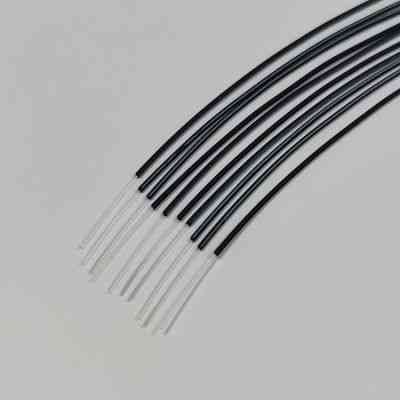
| Probe format | Bare fiber / ceramic package / metal tube / surface-mount patch |
| Fiber protection | Coating / PTFE sleeve / stainless steel armor |
| Channels | Commonly 1 / 4 / 8 / 16, optical switch for multi-point polling |
| Connector | ST / SMA905, matched to instrument interface |
The table above reflects common industry ranges. Temperature range, accuracy, response time and dielectric withstand are confirmed by the selected model datasheet. When selecting, provide the maximum measured temperature, mounting location and alarm response time together.
Applications
HV Switchgear
Breaker contacts, busbar joints, cable terminations. The most mature application: the probe goes directly on live parts, passive and metal-free, without changing the insulation structure.
Transformers & Power Equipment
Winding hot-spot monitoring, dry-type transformer control, reactor monitoring. A thin probe threads into the winding to measure the real hot spot rather than the surface.
Microwave & RF Heating
Microwave digestion, microwave drying, RF hyperthermia. Metal thermocouples arc in a microwave field and infrared is blocked by the cavity. Fluorescent fiber is one of the few options that works.
Medical Hyperthermia
Microwave hyperthermia, RF ablation, MR-environment thermometry. Passive, metal-free, MR compatible, suitable for interstitial temperature monitoring.
Related Products
| Item | Notes | Page |
|---|---|---|
| Silica transmission fiber | UV to NIR transmission, high temperature rating | View HPCF |
| SMA905 / ST connectors | Matched to instrument interface | View |
| Fiber patch cords | Assemblies with armor and sleeve options | View |
| Large core GOF | For higher temperature or larger throughput | View |
Frequently Asked Questions
How does fluorescent fiber temperature sensing work?
A rare-earth doped phosphor at the probe tip is excited by a UV or blue light pulse. After the pulse ends, the fluorescence decays exponentially. The time constant of that decay, the fluorescence lifetime, changes monotonically with temperature: the hotter it is, the faster it decays. The instrument fits the decay curve and derives the temperature. Because it measures time rather than intensity, source aging, fiber bending loss and dirty connectors do not affect the reading.
What are the advantages over thermocouples and infrared?
Thermocouples need metal leads, which pick up interference in high-voltage and strong EMI environments and can even provide a breakdown path. Infrared is limited by emissivity, distance and field of view. A fluorescent fiber probe is passive, non-conductive and immune to EMI, so it can be bonded directly onto live conductors. It is intrinsically safe and needs no periodic recalibration, which is why it became the mainstream choice for switchgear contact monitoring.
What is the temperature range and accuracy?
Standard models cover -40C to +200C, high-temperature versions reach around 400C, depending on phosphor and fiber rating. Accuracy is typically +/-0.5C to +/-1C with 0.1C resolution. Actual values depend on the selected model. Always specify the maximum measured temperature and required accuracy together when selecting.
What probe formats are available?
Bare fiber probes, ceramic encapsulated probes, metal tube probes and surface-mount patch probes. Switchgear contacts usually use ceramic or insulated patch probes, transformer windings use thin probes threaded through the coil, and microwave or medical hyperthermia use media-resistant probes. The package directly affects response time and dielectric withstand, so it must be chosen based on the mounting location.
What fiber material is used?
Silica fiber is standard because it transmits well from UV to near infrared and withstands high temperature. HPCF can reduce cost for short distance ambient applications. Outer protection depends on the environment: coating, PTFE sleeve or stainless steel armor. High-voltage installations also require attention to creepage distance and insulation structure.
How many probes can one instrument handle?
It depends on the channel count of the instrument: commonly 1, 4, 8 or 16, with an optical switch for multi-point polling. Fluorescent lifetime response is typically in the millisecond to second range, so when polling many points check whether the per-point refresh rate meets the protection action requirement. Configuration follows the number of monitoring points and the alarm response time.
Can it be used in medical applications?
Yes. A fluorescent fiber probe is passive, non-conductive and metal-free, which suits microwave hyperthermia, RF ablation and temperature monitoring inside an MR environment where thermocouples and infrared cannot be used. Medical use requires sterilizable packaging and biocompatible materials, confirmed per project.
Need a fluorescent fiber probe solution?
Tell us the measured object, temperature range, mounting location and response time requirement. We will propose the probe format, fiber specification and packaging.
Get Quote