Three Connectors in One Line Each
| Interface | Locking | Action | Ferrule | In one line |
|---|---|---|---|---|
| SC | Square push-pull | Push straight in, grip shell to release | 2.5 mm | Square, push-pull, the default in equipment rooms |
| FC | Round thread | Rotate to tighten, keyed against rotation | 2.5 mm | Round, screw on, instruments and industrial |
| LC | Small form factor latch | Squeeze tab to insert and release | 1.25 mm | Small square, latch, highest density |
Interface Profile Comparison
Two Ferrule Generations: 2.5 mm and 1.25 mm
Half the difference between connectors is the locking method, the other half is ferrule diameter. The ferrule is the precision ceramic tube the fiber passes through and is fixed in. It is the bulkiest and most tolerance critical part of the connector.
| Ferrule | Interfaces | Character | Status |
|---|---|---|---|
| 2.5 mm | SC, FC, ST | Forgiving, less sensitive to contamination and scratching, strong mechanically | SC still widespread; FC narrowed; ST industrial |
| 1.25 mm | LC, MU | Compact and high density, but more sensitive to contamination and scratches | Mainstream for new data centers |
The trade off matters: LC achieves high density not through a better design, but through a smaller ferrule, and a smaller ferrule means a more fragile end face. The same dust particle covers a much larger share of a 1.25 mm face than of a 2.5 mm face. Where LC is used, cleaning discipline and inspection frequency must increase accordingly, otherwise the higher failure rate will consume the operational savings.
Colour Coding: The First Quick Check
| Colour | Meaning | End face | Watch out |
|---|---|---|---|
| Blue | Singlemode UPC | 0° micro sphere | Most common, but not all singlemode |
| Green | Singlemode APC | 8° angled | Must never be mated with blue |
| Beige / grey | Multimode OM1 / OM2 | PC flat | Common in older rooms |
| Aqua | Multimode OM3 | PC | Very close to singlemode blue in dim light |
| Magenta / violet | Multimode OM4 | PC | — |
| Lime green | Multimode OM5 | PC | Less common |
Two points to remember:
First, blue does not mean singlemode, blue means singlemode UPC. Singlemode APC is green. Treating "blue equals singlemode" as a rule leads to misjudging every green connector.
Second, OM3 aqua is visually very close to singlemode blue. Rack lighting is often dim, and telling them apart by eye fails. Colour is a first check only; the label or test data must confirm.
UPC versus APC: Mixing Them Damages End Faces
This is the most common and most hidden field failure. Both ends look normal, the link passes light, but loss stays high and return loss fails specification. Troubleshooting usually blames the splice, then the fiber quality, before someone finally checks the grind angle.
Remember the rule: blue to blue, green to green, never mate mismatched colours. Where both UPC and APC exist on the same site, separate them physically at the label and cable management level rather than relying on people to remember.
Singlemode versus Multimode
| Item | Singlemode | Multimode |
|---|---|---|
| Core | 9/125 μm | 50/125, 62.5/125 μm |
| Typical wavelength | 1310 / 1550 nm | 850 / 1300 nm |
| Reach | Kilometres to tens of kilometres | Hundreds of metres for OM3 / OM4 |
| Source | Laser (DFB / FP) | VCSEL |
| End face | UPC (blue) or APC (green) | PC (beige / aqua / magenta) |
| Return loss | UPC 50 dB, APC 60 dB | 20 dB or better |
| Connectors | SC / LC / FC | SC / LC / ST |
The connector body can be structurally identical (both SC, or both LC), but the fiber type must be consistent along the whole link. Core size and NA differ completely, and a mixed link simply does not work. Always confirm both fiber type and connector model: "I need an SC patch cord" is not enough information.
Selection in Three Questions
| Order | Question | Why first |
|---|---|---|
| 1 | What interface is on the equipment receptacle? | The interface cannot be changed, it governs everything. An SC plug does not enter an LC receptacle |
| 2 | Singlemode or multimode? | Determines fiber specification; a mixed link does not work |
| 3 | UPC or APC? | Determines end face angle; mixing damages end faces |
Once these three are answered the specification is essentially fixed. What remains is length, jacket (PVC, LSZH, armoured) and simplex or duplex, all of which follow the installation and do not affect whether the part works.
Conversely, an enquiry reading only "SC patch cord, 3 metres" is missing questions 2 and 3, and must be clarified or the wrong part will be supplied.
Key Parameters
| Item | SC | FC | LC |
|---|---|---|---|
| Ferrule diameter | 2.5 mm | 2.5 mm | 1.25 mm |
| Locking | Square push-pull | Thread with key | Small latch |
| Insertion loss (SM UPC) | 0.3 dB max | 0.3 dB max | 0.3 dB max |
| Return loss (UPC) | 50 dB min | 50 dB min | 50 dB min |
| Return loss (APC) | 60 dB min | 60 dB min | 60 dB min |
| Mating cycles | 1000 or more | 1000 or more | 1000 or more |
| Operating temperature | -40 to +85C | -40 to +85C | -40 to +85C |
| Typical use | Equipment rooms, data centers, FTTH | Test instruments, sensing, industrial, legacy rooms | High density data centers, SFP modules |
Figures above are common industry reference values. Actual performance follows the datasheet and project technical agreement, and acceptance should be judged on the distribution of lot sampling data rather than a single sample.
Why FC Has Not Disappeared
New data centers use SC and LC almost exclusively, and FC is rare there. But FC survives because its strengths land in different applications:
Threaded lock resists vibration
Push-pull and latch types can work loose under sustained vibration; a tightened thread does not. Machine tools, construction equipment and vehicle test benches favour FC.
Key prevents rotation
FC usually carries a key that fixes the angular position once seated, giving better repeatability across matings than a plain push-pull. Test instruments and spectroscopy equipment value this.
Durable metal shell
A full metal body resists wear, temperature and mechanical impact, suiting industrial sites and high cycle test benches.
Installed base maintenance
Large numbers of early telecom rooms and dedicated equipment have FC receptacles on the panel, so replacement demand continues.
FC is not obsolete, its application range has narrowed. The rule: LC for new high density builds, SC for general equipment rooms, FC for vibration environments, test benches and legacy equipment maintenance.
End Face Cleaning: Easier to Get Wrong Than Selection
This step is skipped most often and causes the most failures. The ferrule end face is only around 125 micron across, so a speck of dust invisible to the eye can cover a large share of the transmitting area.
| Wrong practice | Consequence | Correct practice |
|---|---|---|
| Blowing on it | Does not clean, and adds moisture droplets | Dedicated cleaning pen or cassette |
| Wiping with clothing or tissue | Leaves fiber debris and can scratch | Lint free wipe with anhydrous alcohol, one direction |
| Reusing one cloth across many faces | Transfers contamination from one face to the next | One use per face, or disposable cleaning tape |
| Mating without inspection | Carries contamination into the equipment receptacle | Inspect with a scope before mating |
In high power links this is critical: the contaminant absorbs energy and burns a pit, and a burnt end face cannot be repaired, only replaced.
Related Products
| Item | Notes | Page |
|---|---|---|
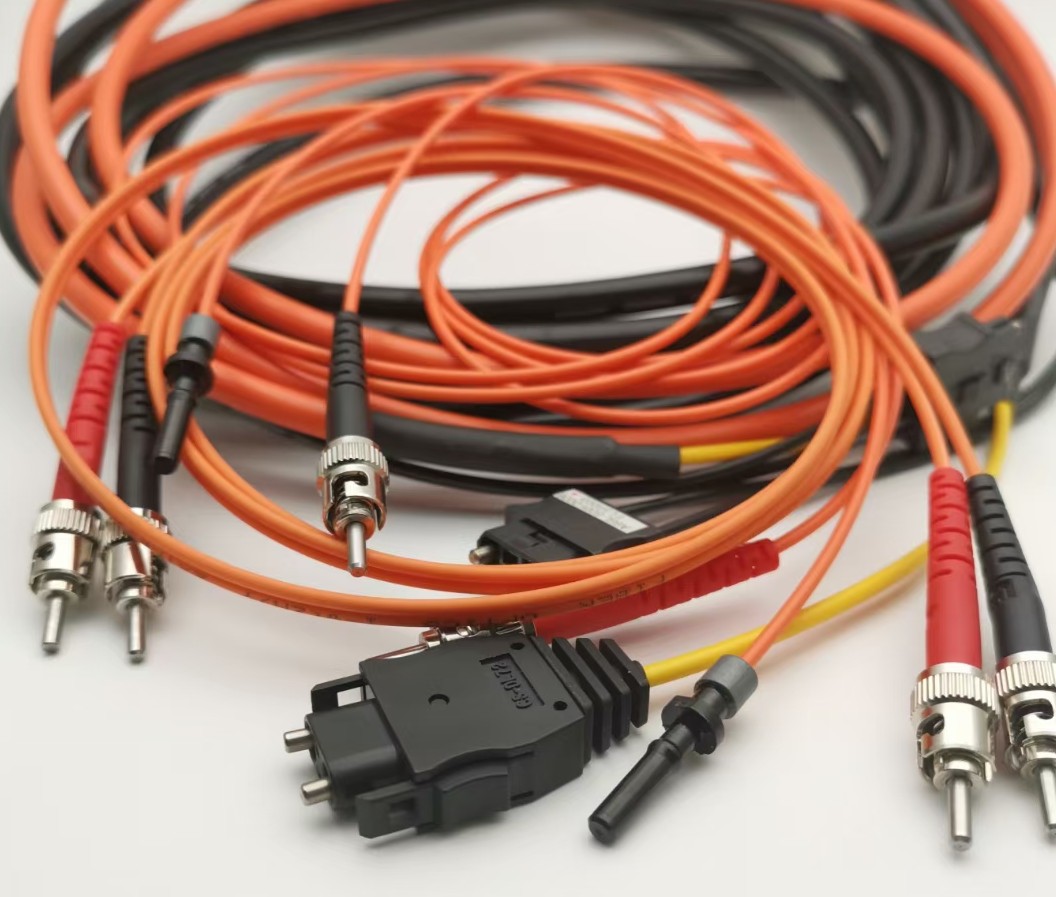
| ST connectors | Bayonet, industrial and sensing | View |
| SMA905 connectors | Threaded, medical and high power | View |
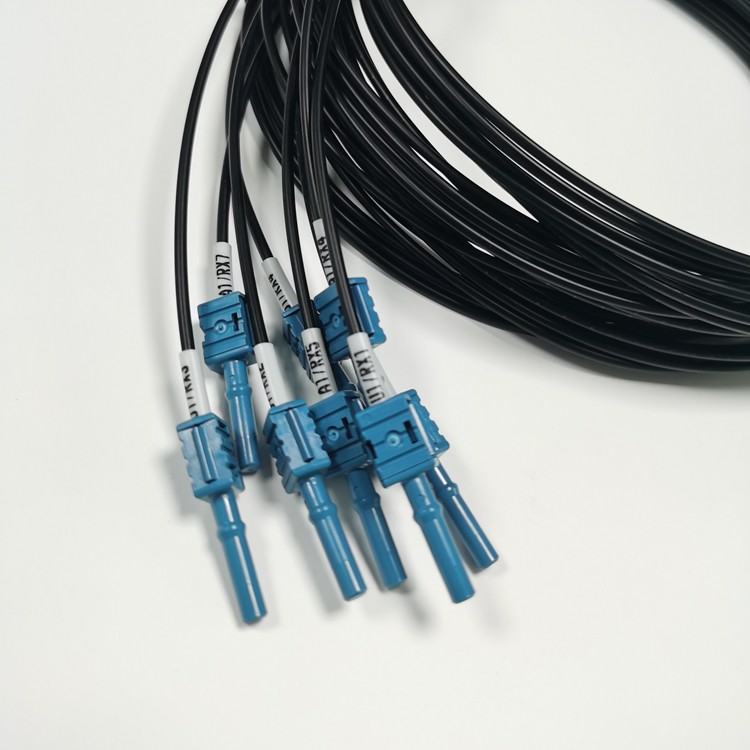
| F05 / F07 industrial optical connectors | Dedicated servo and PLC interface | View |
| Specialty patch cords | Custom length and connector combinations | View |
| H-PCF hard clad silica fiber | Fiber for industrial optical links | View |
Frequently Asked Questions
Can UPC and APC be mated?
No. A UPC end face is a micro sphere ground at 0 degrees, while an APC end face is angled at 8 degrees. Mated together the faces cannot sit flat, an air gap forms between them, insertion loss and return loss both degrade, and the angled contact can damage the end face. This is the most common field mistake because both ends look normal from outside. Colour is the first check: singlemode UPC is blue, singlemode APC is green, never mate mismatched colours.
Does blue always mean singlemode?
Not exactly. Blue means singlemode UPC, not all singlemode. Singlemode APC is green. Multimode OM3 is aqua, which is visually close to the singlemode blue and easy to confuse in a dim rack. Colour is a quick first check only; final confirmation must come from the label or test data.
How do I tell SC, FC and LC apart quickly?
By locking method and shell shape. SC has a square shell with push-pull action: push straight in, grip the shell to release, no rotation. FC has a round metal shell with a thread that must be tightened, usually with a key to prevent rotation. LC is the small form factor with a press latch: smallest of the three, release by squeezing the small tab. Size alone is usually enough, LC is clearly smaller than SC and FC.
Why is LC density so much higher than SC?
Because the ferrule drops from 2.5 mm to 1.25 mm. The ferrule is the bulkiest part of the connector, so halving its diameter greatly reduces the panel area per port and allows many more ports at the same panel height. LC is commonly built as a duplex body with two ports integrated, one latch locking both channels. The trade off is a smaller end face that is more sensitive to contamination and scratching, so cleaning discipline must be stricter.
Can singlemode and multimode connectors be used interchangeably?
The connector body may be structurally the same, but they cannot be mixed in practice. Singlemode uses a 125 micron cladding with a ferrule bore around 126 micron; multimode is commonly 125 micron cladding with similar bore but different end face and concentricity requirements. More importantly the fiber type must be consistent along the whole link, because core size and NA differ completely and a mixed link simply does not work. Always confirm both fiber type and connector model when ordering.
What are the acceptance limits for insertion loss and return loss?
Common industry reference: singlemode UPC insertion loss 0.3 dB or less and return loss 50 dB or more; singlemode APC insertion loss 0.3 dB or less and return loss 60 dB or more; multimode insertion loss 0.3 dB or less and return loss 20 dB or more. Actual acceptance follows the project technical agreement and should be judged on the distribution of lot sampling data, not on a single sample, because a passing sample does not prove lot consistency.
Is FC still widely used?
New data centers and equipment rooms use SC and LC almost exclusively, and FC is rare there. But FC remains common on test instruments, spectroscopy equipment, sensing systems and some industrial equipment, because the threaded lock resists vibration, the metal shell is durable and alignment is stable. There is also a large installed base of early telecom rooms and dedicated equipment with FC receptacles, so replacement demand continues. FC is not obsolete, its application range has narrowed.
How important is end face cleaning really?
Critical, and it is the step most often skipped in the field. The ferrule end face is only around 125 micron across, so a speck of dust invisible to the eye can cover a large share of the transmitting area and cause a sudden loss increase. In high power links the contaminant absorbs energy and burns a pit, and a burnt end face cannot be repaired, only replaced. Clean with a proper tool before every mating, do not blow on it, do not wipe with clothing, and do not reuse one cloth across multiple end faces.
Need SC / FC / LC connectors or patch cords?
Provide the equipment receptacle interface, singlemode or multimode, UPC or APC, plus length and jacket requirement. Once these are confirmed we can quote. Non standard lengths and connector combinations available.
Get Quote